
Bali — Investor Guide 2026
Buying property in Bali — the honest guide
Yields, sub-regions, the leasehold land structure, the developers worth trusting, and the one mistake that costs foreign buyers six figures. Written by someone who has been working the Bali market for eight years.

A note from Chris
I've been selling Bali property to international buyers for eight years. We've worked the same handful of trusted developers throughout — a small group, deliberately — because Bali is the market where the most foreign-buyer disasters happen and the gap between a good deal and a six-figure write-off is wider than anywhere else we operate.
Bali offers some of the highest yields in the HPA universe. Twelve to eighteen percent gross is achievable on the right villa in the right sub-region. It also has the most complex ownership structure of any country we cover — which is exactly why people get burned here.
Most of this page is about how to make Bali work. One section is about why so many foreign buyers lose money. Read both. If you only read one, read the second.
Section 1
The Bali market snapshot — 2026
Bali has been the highest-yielding international property market in the HPA universe for three years running. Post-Covid tourism recovery overshot every projection — Bali airport arrivals are running 15 percent above 2019 peaks, with nightly rate inflation running faster than supply growth. Short-term rental occupancy in the prime sub-regions is sustained between 75 and 90 percent year-round.
The yields reflect this. A well-located 2-bedroom villa in Berawa or Pererenan can produce 12 to 18 percent gross. The same villa in Canggu central will do 10 to 14 percent because the entry price has risen faster than the rental rate. The trade-off is location risk versus yield ceiling.
Three macro factors matter for foreign buyers in 2026. First, Bali property is priced in US dollars in the prime markets — which is genuinely useful for buyers paying in USD, AUD or GBP, because you're not exposed to Indonesian Rupiah volatility. Second, the Indonesian government has materially improved the visa landscape for foreign owners over the past two years. Third, the regulatory environment around short-term rentals is tightening — but only for non-compliant operators. Properly licensed villas are fine and that's exactly what we put members into.
Section 2
Six Bali sub-regions, ranked by current opportunity
Most foreign buyers see Bali as one market. It isn't — these six sub-regions behave like six different countries. Order matters.

Canggu — established short-let, saturated
Where the foreign-money Bali story has been told for the last decade. Surfers, digital nomads, and the highest concentration of beach clubs on the island. Yields are still strong but the supply has caught up — new builds compete with thousands of existing villas. Best for buyers who want immediate cashflow and don't mind paying a premium for a proven micro-market.

Berawa & Pererenan — next-wave Canggu
Twenty minutes north of central Canggu, sharing the same beach but at last year's prices. The infrastructure is racing to keep up — beach clubs, restaurants, co-working spaces all opening at pace. This is where the smart Canggu money is going right now. Yields are higher because the supply hasn't fully arrived yet.

Uluwatu & Bukit — luxury cliffs
The premium end of the island. Clifftop villas with Indian Ocean views, ten minutes from world-class surf, twenty minutes from the airport. Yield is lower than Canggu but capital growth has been strongest here over the past five years and the buyer demographic — high-net-worth Australians and Singaporeans — is more reliable. Best for capital appreciation plays.

Ubud — cultural and wellness
Bali's cultural and wellness heart. Surrounded by rice terraces and jungle, not the beach. Tenants stay longer — weeks rather than days — which means less management overhead and more reliable monthly numbers. Best for owners who want lower seasonality and a property they'd actually enjoy spending time in themselves.
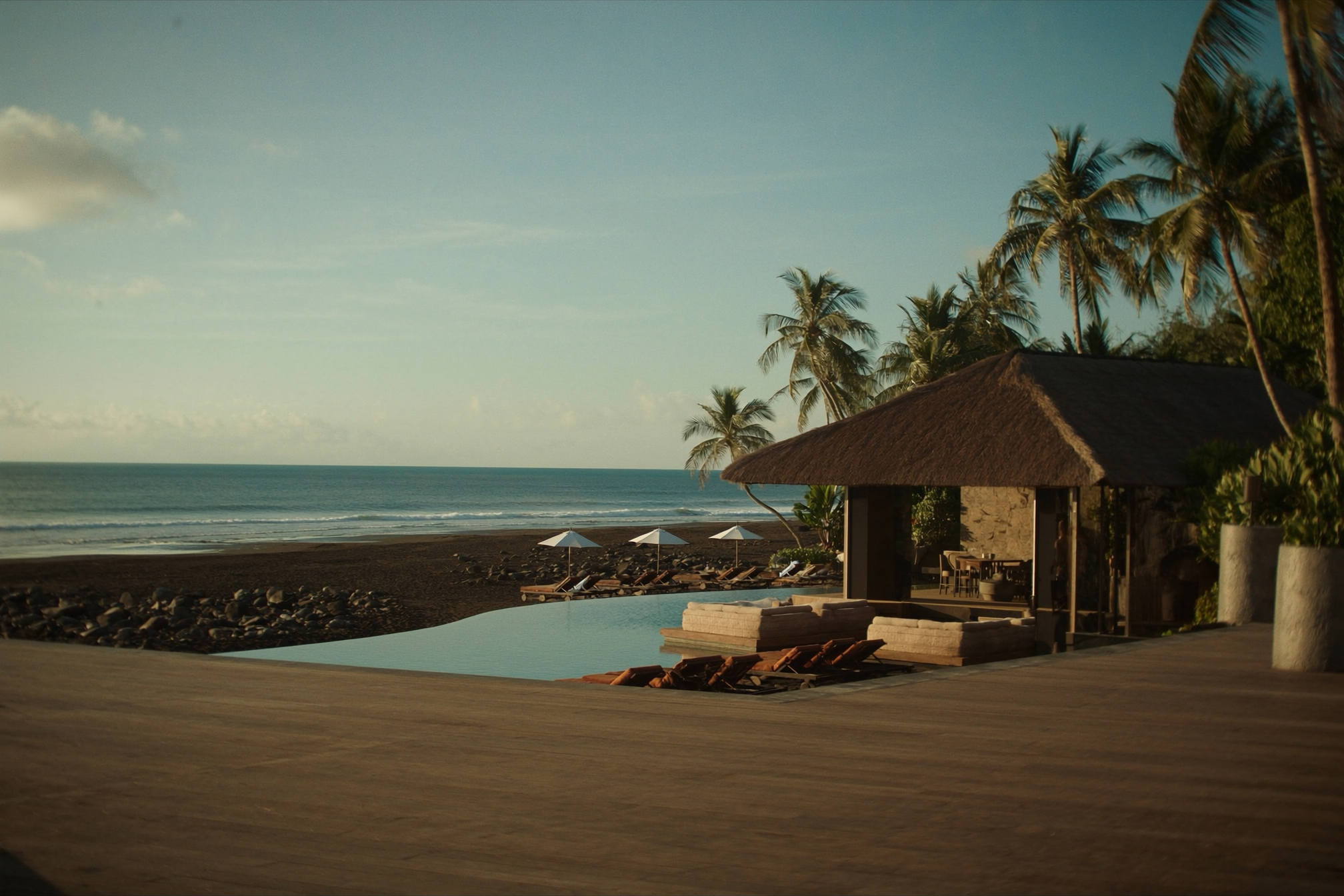
Seminyak — established luxury
The Mayfair of Bali. Established beach clubs, designer shopping, fine dining. Yields are tighter than Canggu because purchase prices are higher, but the buyer base is older, wealthier, and more loyal. If your strategy is fewer transactions at higher value, Seminyak rewards it. Not for the cashflow buyer.

Sanur — quieter, family, reliable
The forgotten corner of south Bali. Calm beach, family-friendly, lower-key, no surfer crowds. The Sanur buyer is typically Australian or European, often retired or semi-retired, often spending three to six months a year here. Yields are lower than Canggu but the tenant churn is far lower, which means real net returns are surprisingly competitive.
Section 3
The land-structure trap — where most buyers lose money
Indonesian law is straightforward: foreigners cannot own freehold land. Period. What you can own is leasehold — typically 25 or 30 years with extension clauses — or property held through a PT PMA company structure.
Most of the time, the leasehold route is totally fine. Bali villas are cashflow plays, not generational holds. A clean 30+ 30 leasehold contract with extension language that holds up under Indonesian law is a perfectly safe structure for a 10-to-20-year investment horizon.
The trap is the developers who quietly structure deals via Indonesian nominees, or who promise extensions that aren't actually documented, or who sell land they don't fully control. We've seen six-figure villa investments evaporate because of one missing clause in the leasehold contract. We've seen entire developments collapse because the underlying land title wasn't clean. We've seen buyers told they “own” through a nominee arrangement that doesn't survive Indonesian regulatory tightening.
There are maybe four developers in Bali I'd trust to do the structure properly. That's the actual product HPA gives you access to in this market — not just “a deal in Bali,” but a deal where the underlying paperwork has been independently verified by lawyers we've worked with for years.
Section 4
Tax, visas, and the holding structure
Two structures dominate foreign buying in Bali — leasehold and PT PMA. Leasehold is the simpler route, used by the majority of villa investors. You hold the lease in your personal name, rental income is taxed at 10 percent for non-residents, and you can typically lease back the property to the developer for management.
PT PMA is the more sophisticated route. You set up an Indonesian foreign-owned company, the company holds Hak Pakai (freehold-equivalent) rights, and the company is your operating and tax entity. Setup costs are $3K–$8K, ongoing compliance costs are $2K–$5K annually, but the tax efficiency on rental income improves materially and you can hold multiple properties through the same structure. PT PMA also qualifies you for KITAS work permits, which means you can legally live in Indonesia.
On visas more broadly, the picture has improved fast. The Second Home Visa (introduced 2023) gives 5–10 year stays for buyers with $130K+ invested. The B211A visit visa is 60 days extendable to 180. KITAS gives full residency through PT PMA or marriage. Owning Bali property doesn't automatically give you any of these — but it's often what triggers buyers to apply.
Section 5
Currency in Bali — simpler than it looks
Most Bali villa transactions priced for foreign buyers are quoted in US dollars. The developer holds offshore USD accounts, the contract specifies USD as the payment currency, and the leasehold itself is USD-denominated. This is good news for international buyers because it removes the Indonesian Rupiah from your risk equation entirely.
For UK, EU, and Australian buyers, your only currency consideration is your home currency to USD — the same consideration you'd have on any USD-denominated investment. Sterling has been broadly stable to slightly stronger against USD over the past 18 months. Australian buyers are slightly disadvantaged compared to 2021 levels but not significantly.
Use a specialist currency broker for the transfer, not a high-street bank. We have two preferred currency partners used by HPA members — both will lock the rate forward for the 12–24 months a typical Bali off-plan completion timeline takes.
Section 6
Bali developers — three categories, four trusted operators
The Bali developer landscape sorts into three categories.
Tier one — long-track-record operators. A small group — maybe four firms — with 10+ years of completed villa projects, clean land titles, proper leasehold documentation, and verifiable buyer testimonials. They charge more per square metre but they finish on time, the build quality is genuinely high, and the legal structure holds up. These are the only developers HPA places members with.
Tier two — competent newer operators. A larger group of developers who've emerged in the post-Covid boom. Some are genuinely good but lack track record. Some are good builders but weak on the legal structure side. Some are good marketers with thin operational depth. Members occasionally see deals from this tier when our in-house lawyer has independently verified the structure.
Tier three — Instagram syndicators. Smaller operators marketing aggressively to foreign buyers via Instagram, YouTube and influencer partnerships. Some are completely legitimate small developers. Many are not. This is where the catastrophic Bali stories almost always come from — missing land titles, missing extensions, missing developers. Diligence here is everything and even with diligence the downside risk is real.
Inside HPA we work with four Bali developers. Four. That is the entire approved list. It's a small number on purpose — it's the number of operators we'd let a family member buy from.
Why this guide exists
Who is writing this, and why does it matter

Chris White built Ideal Homes Portugal from a single Algarve office in 2012 into a forty-person property business with a sister company selling across more than twenty countries. Bali has been part of that network for eight years.
Multiple European Property Awards. The Apple Tree Lane development with Duncan Bannatyne of Dragons' Den. TV appearances on Channel 4's “Sun, Sea and Selling Houses.” Speaking on stage with Tony Robbins, Arnold Schwarzenegger, and Samuel Leeds. None of it accidental.

Why the awards matter for Bali
Property awards are easy to dismiss. But the European Property Awards are judged by an independent seventy-person panel that actually verifies operations, looks at financial accounts, and audits client outcomes. Winning them repeatedly is how you signal that your underlying business isn't built on marketing.
That same standard is what HPA brings to the four Bali developers we work with. Verified track record. Audited paperwork. Real client outcomes. The structure that makes Bali safe to buy in.

The rooms he's in
Chris has shared stages with Tony Robbins, worked alongside Duncan Bannatyne for over a decade, and met with everyone from Arnold Schwarzenegger to Samuel Leeds across the international property and business circuit.
The point isn't the names. The point is the access. The Bali developers we work with don't take cold approaches from foreign buyers. They take introductions. The HPA membership is, in one practical sense, your introduction.

Beyond the numbers
Three Africa missions including Operation Smile alongside Duncan Bannatyne. A 2023 Uganda mission with Samuel Leeds. Ongoing work with healthcare and education charities across the countries Chris's businesses sell into.
Not directly relevant to a Bali property decision. But it tells you something about the kind of business operator he's built. The people you let into your financial life should be the people who care about what happens to other people's money.
Why Hot Property Alerts exists
The four trusted developers, bottled into a membership
After eight years working the Bali market, Chris kept seeing the same pattern. Smart, capital-ready buyers — Australians, Brits, Singaporeans, Americans — would arrive in Bali looking for the villa they'd been dreaming about. They'd already done their homework. They'd watched the YouTube videos, read the blogs, talked to the agents who came up first on Google.
And then they'd sign with a developer whose land title wasn't clean. Or they'd enter a nominee arrangement that wouldn't survive an Indonesian regulatory check. Or they'd buy in a sub-region with the wrong zoning for the short-term rental strategy they had in mind. The information they'd found online was either an advert for a specific developer, or a generic Bali overview written by someone who had never closed a villa transaction in their life.
Hot Property Alerts is the thing Chris wished those buyers had access to before they made their decisions. The four trusted Bali developers. The Bali-experienced lawyers we use to vet every paper trail. The currency partners. The tax advisors who understand the PT PMA structure. The weekly workshops where you can ask Bali-specific questions directly. The SMS line where you can text the team and get a real human answer the same day.
What used to require eight years of trial and error to access in Bali is now available to anyone serious enough to join the membership. £99 a month gets you the intel layer — country reports, weekly workshops, deal previews, SMS access, the partner directory. That's the version most members start with.
If Bali is genuinely your next move, Insider is the cheapest piece of professional intel on the market. If you're still figuring out which country to commit to, Insider is still the cheapest way to find out — because the same membership covers every market we work in.
Either way, the next step is below.
The next step
What HPA Insider gives you for Bali
Membership is £99 a month. Cancel any time. No questions asked.
- ✓Monthly Bali market report — sub-region rankings, yield trajectories, what we are watching
- ✓Weekly live workshop with Chris — deal walkthroughs, open Q&A, current Bali market read
- ✓Pre-vetted deal pipeline — only from the four trusted Bali developers, with paperwork verified
- ✓Trusted partner directory — the Bali-experienced lawyers, tax advisors and currency partners we use ourselves
- ✓Direct SMS line to the HPA team — text us your Bali question, real human answer the same day
- ✓First look at every new briefing, index and country report before they go public
Cancel any time. No questions asked.
Common questions
Bali property FAQ
Can foreigners actually own property in Bali?
Not freehold land — Indonesian law restricts that to citizens. What you can own is leasehold (typically 25 or 30 years with extension clauses) or hold property through a PT PMA (foreign-owned company) structure. Both are well-established legal routes used by tens of thousands of foreign owners. The key is to use them correctly, with proper paperwork and the right local lawyer.
What is the leasehold structure and is it safe?
A Bali leasehold is a contract giving you full beneficial use of the land for a fixed term — typically 25 or 30 years — with extension clauses that allow renewal for another 25 or 30 years. Done properly with a reputable developer and an independent lawyer, it's a transparent and well-understood structure. Done badly — with vague extension language, missing land certificates, or nominee arrangements that don't comply with current Indonesian law — it can collapse. The legal documentation is everything in Bali.
What's the difference between leasehold and PT PMA?
Leasehold gives you the use of the land but not the underlying ownership. PT PMA is a foreign-owned Indonesian company that can hold property in 'Hak Pakai' (Right to Use) form, giving the company freehold-equivalent rights. PT PMA is more complex and requires ongoing compliance, but it's the right structure for higher-value investments or operating businesses. Most short-let villa buyers use leasehold; serious portfolio investors often use PT PMA.
Can I get a mortgage on a Bali property?
Mortgages on Indonesian property are difficult for foreign buyers — Indonesian banks typically do not lend to non-residents, and international banks generally do not lend on Indonesian land. The realistic financing routes are: developer-financed instalment plans (common for off-plan), home-country equity release (using a UK, US or Australian property as security), or all-cash purchase. Plan for cash unless the developer offers an instalment plan.
What's the realistic short-term rental income?
Highly location-dependent. A 2-bedroom Canggu villa runs $30K–$60K USD gross per year. A 3-bedroom Uluwatu cliff villa runs $50K–$120K. The right Pererenan or Berawa property at the right entry price can hit 15 percent gross yield in year one. Operating costs (management, maintenance, utilities) typically take 25–35 percent of gross, so net yields run 8–14 percent — strong by global standards but variable.
Are short-term rentals still legal in Bali?
Yes, with the right licensing. Indonesia has been tightening regulation around villa rentals — particularly around tax compliance and zoning — but legitimate operators are still operating with no issue. The risk is buying a property in a zone where short-term rentals are not permitted, or operating without proper licenses. We confirm zoning and licensing on every deal before passing it to members.
What about visas — can I actually stay there?
Indonesia's visa landscape has improved dramatically for foreign property owners. The B211A visit visa allows 60-day stays with extensions. The new Second Home Visa allows 5–10 year stays for buyers meeting investment thresholds. The KITAS work-permit route is available for those running a PT PMA. None of this is automatic with property purchase — but options exist for buyers who want extended time on the island.
What taxes will I pay on a Bali property?
Acquisition tax (BPHTB) of 5 percent on transfer, plus annual land and building tax (PBB) of around 0.1–0.3 percent of assessed value. On rental income, tax is generally 10 percent for non-residents or 20 percent through a PT PMA structure (with deductions available). For sophisticated buyers, the tax structure of the holding entity matters more than the surface rates — which is where a Bali-experienced tax advisor (we have two in the partner network) earns their fee.
Haven't taken our quiz yet?
Find your best-fit market in sixty seconds
Bali might be the right answer. It might not. Our quiz takes your capital, timeline and goals, and matches you to the country most likely to deliver — then sends a personalised briefing to your inbox.
Take The 60-Second Quiz